1
1
1
Simon Bolivar Buckner, Jr.
Commanding Officer 22nd Infantry
September 1938 - November 10, 1939
As a Colonel, Simon B.
Buckner Jr., commanded the 22nd Infantry Regiment
at Ft McClellan in 1938-1939.
The Official US Army Register entries for Simon B. Buckner Jr.:
Born in Kentucky July 18, 1886.
He entered the US Military
Academy on June 16, 1904. He graduated 58 out of a class of 108
on February 14, 1908.
In his graduating year he was a Lieutenant in the Corps of Cadets
in Company A. Upon graduation he was commissioned
a 2nd Lieutenant in the 9th Infantry. He was promoted to 1st
Lieutenant on August 5, 1914. On September 1, 1915
he was transferred to the 27th Infantry. He
received a promotion to Captain on May 15, 1917.
On August 5, 1917 Buckner was
offered the temporary rank of Major in the Signal Corps which he
accepted on
September 27 of that year. On January 24, 1918 he was temporarily
promoted to Major of Infantry and he vacated the
Signal Corps assignment on May 27, 1918. He held the temporary
rank of Major of Infantry until August 20, 1919.
On July 1, 1920 Buckner was
promoted to the permanent rank of Major in the Regular Army. In
1924 he graduated
from the Infantry School Advanced Course and in 1925 he was a
Distinguished Graduate of the Command and
General Staff School. In 1929 he graduated from the Army War
College.
On April 1, 1932 Buckner was
promoted to Lieutenant Colonel. He was promoted to Colonel on
January 11, 1937.
From October 17, 1939 to May 28, 1940 he was a member of the
General Staff Corps.
Buckner was promoted to
Brigadier General on September 1, 1940 and to Major General on
August 4, 1941.
On May 4, 1943 he was promoted to Lieutenant General.
He was killed in action on June 18, 1945.
On July 19, 1954 Buckner was posthumously promoted to the rank of General ( Four-Star ).
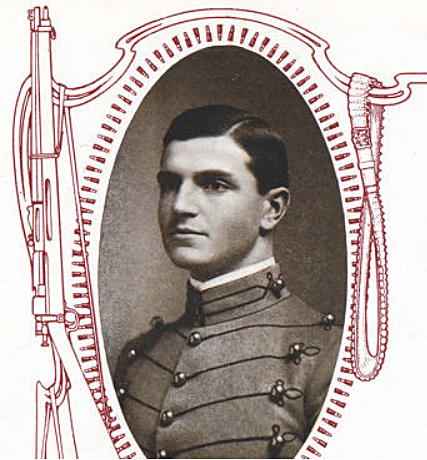
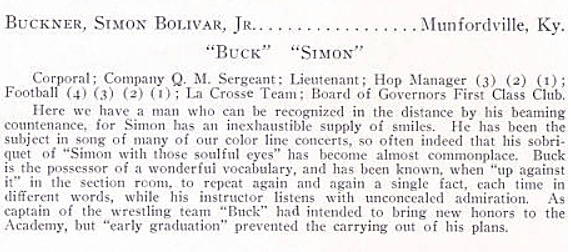
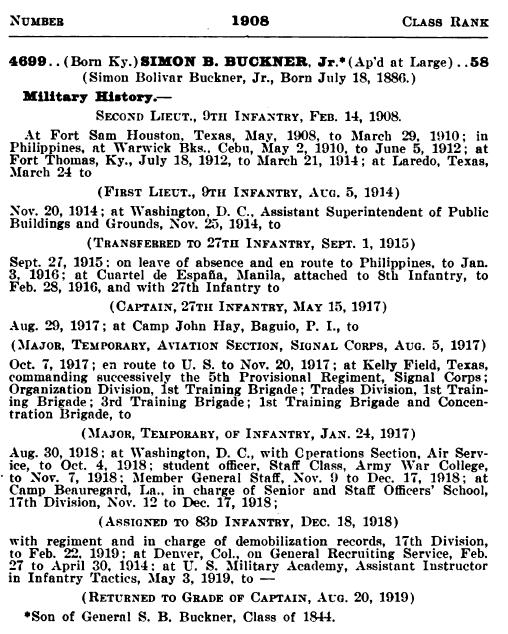
The following is the listing for Simon
B. Buckner Jr.,
in the 1908 "Howitzer" (West Point yearbook)
Buckner's early service, from 1908 to 1919, is outlined in detail in Cullum's Register of 1920:
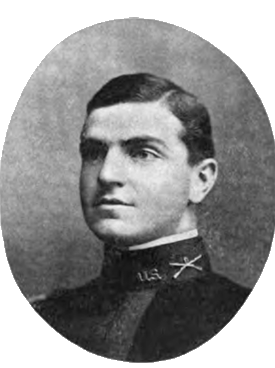
Buckner as a 2nd Lieutenant in the 9th Infantry, ca. 1908-1909
Photo from HISTORY OF THE NINTH
U.S. INFANTRY 1799-1909
by Captain Fred. R. Brown, Adjutant, Ninth Infantry, R.R.
Donnelley & Sons, Co. 1909
|
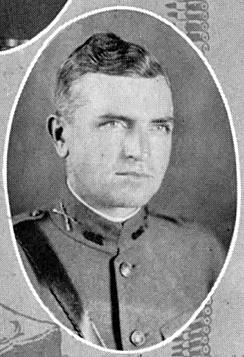
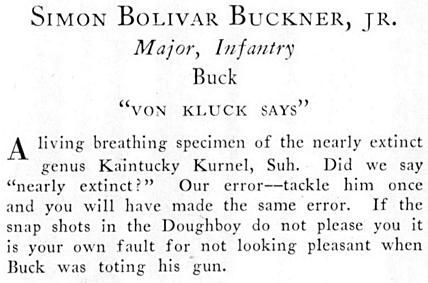
Buckner's entry, as a Major, in
the yearbook for the |
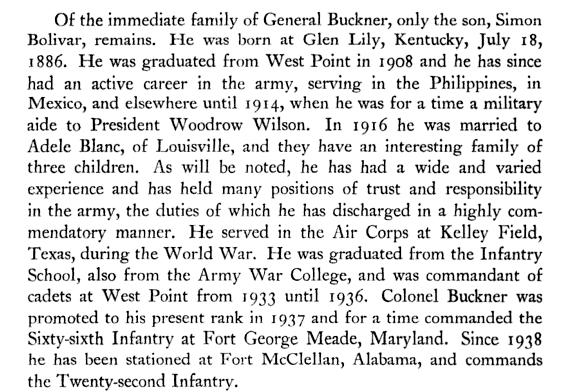
The following passage
from a book originally published in 1940
shows Simon B. Buckner Jr. in command of the 22nd Infantry.
 3
3
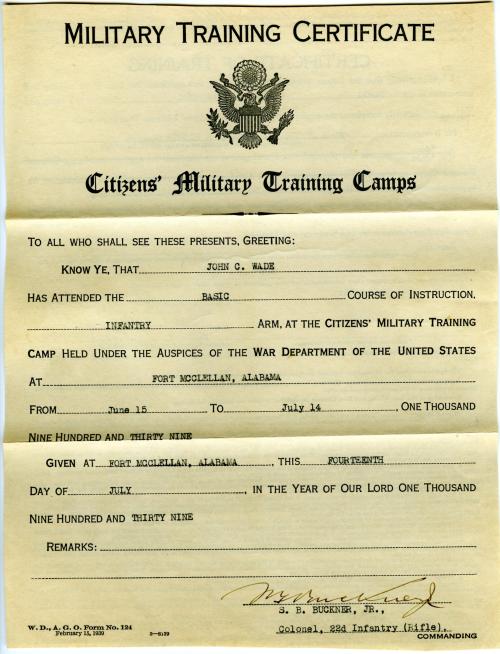
CMTC graduation certificate signed by
Simon B. Buckner Jr., at Fort McClellan 1939,
as a Colonel and Commanding Officer of the 22nd Infantry
webmaster's collection
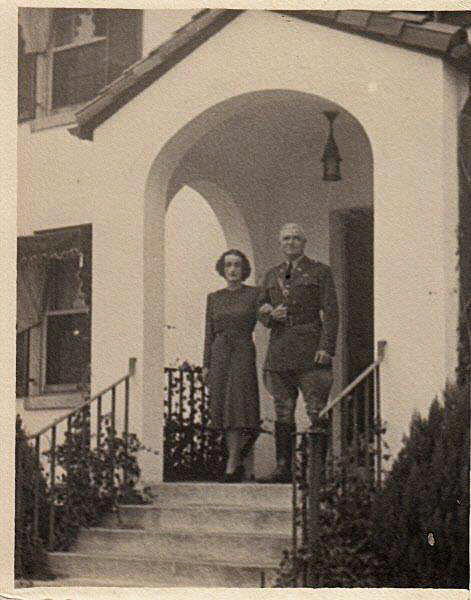
Colonel Buckner and his wife Adele, in
front of their home, Quarters # 1 at Fort McClellan, Alabama.
At the time this photo was taken, Colonel Buckner was Commander
of the 22nd Infantry.
Photo courtesy of William C. Buckner
The following is a summary of Simon B. Buckner Jr.'s military service as compiled by Major General Herbert M. Jones:
AGAR-SC 201 Buckner, Simon B.,
Jr.
02 370 (3 Nov 56)
Military History of Simon B. Buckner, Jr. 02 370
Lieutenant General, Army of the United States (Deceased)
Born: 18 July 1886, Munfordville, Kentucky
Service: Over 41 years
Schools Attended: US Mil Academy, West Point, NY, BS, 1908; Crs
[course] for Gen Staff Offs, Army War College,
Wash, DC, 1918; Adv Crs, The Inf Sch, Ft Benning Ga, 1924;
Command & Gen Staff Sch, Ft Leavenworth, Kan, 1925;
Army War College, Wash, DC, 1929.
US Decorations & Awards: Distinguished Service Cross;
Distinguished Service Medal; Distinguished Service Medal (Navy);
Purple Heart (Posthumous); American Defense Service Medal with
Foreign Service Clasp; Asiatic-Pacific Campaign Medal
with one (1) Bronze Service Star for battle participation in the
Ryukyus Campaign; World War II Victory Medal;
World War I Victory Medal.
Grades Held: Attended USMA fr 16 Jun 04 to 13 Feb 08; aptd 2d Lt,
Inf, RA, 14 Feb 08; acc & EAD 14 Feb 08;
1st Lt, Inf, RA, 5 Aug 14; capt, Inf, RA, 15 May 17; temp maj,
Sig C, 5 Aug 17; temp maj, Inf, 24 Jan 18; maj, Inf, RA,
1 Jul 20; lt col, Inf, RA, 1 Apr 32; col, Inf, RA 11 Jan 37; brig
gen, RA, 1 Sep 40; maj gen, AUS, 4 Aug 41; lt gen, AUS,
4 May 43; KIA 18 Jun 45 on Okinawa.
Assignments: From Jun 04 to Feb 08, attended USMA, West Point,
NY; Feb 08 to May 08, leave; May 08 to Dec 17, duty
with 9th & 27th Inf Regts at various stations in the United
States and in the Philippines; Dec 17 to Sep 18, CO 5th Prov
Regt,
1st Tng Brigade, and CO, 3d Tng Brigade, Kelly Fld, Tex; Sep 18
to Oct 18, temporary duty with Operations Sec,
Dept of Mil Aeronautics, Wash DC; Oct 18 to Nov 18, Student,
Course for Gen Staff Offs, Army War College, Wash, DC;
Nov 18, to Mar 19, In charge Senior & Staff Offs Schs &
assisting in demobilization, Hq 17th Inf, Cp Beauregard, La;
Mar 19 to May 19, Recruiting duty, Denver, Colo; May 19 to Sep
23, Co Commander & Bn Commander,
US Corps of Cadets, West Point, NY; Sep 23 to Jul 24, Student,
The Inf Sch, Ft Benning, Ga; Jul 24 to Sep 24, leave;
Sep 24 to Sep 25, Student, Command & Gen Staff Sch, Ft
Leavenworth, Kan; Sep 25 to Aug 28, Instructor,
The General Service Schs, Ft Leavenworth, Kan; Aug 28 to Jul 29,
Student, Army War College, Wash, DC; Jul 29 to Jul 32,
Executive Off, Army War College, Wash, DC; Jul 32 to Sep 36, Asst
to Commandant & Commandant of Cadets,
US Mil Academy, West Point, NY; Sep 36 to Mar 37, Executive Off,
23d Inf, Ft Sam Houston, Tex; Mar 37 to Sep 38,
CO 66th Inf (Light Tank), Ft Geo G Meade, Md; Sep 38 to Nov 39,
CO, 22d Inf, Ft McClellan, Ala; Nov 39 to Jun 40,
Chief of Staff, 6th Div, Cp Jackson, SC, Ft. Benning, Ga, &
Cp Beauregard, La; Jun 40 to Aug 40 leave and en route
to Alaska; Aug 40 to Jun 44, duty with and CG, Alaskan Defense
Command, Ft Richardson, Alaska; Jun 44 to Sep 44,
assigned to Central Pacific Area, Ft Shafter, TH; Sep 44 to 18
Jun 45 CG, Tenth Army, US Army Forces,
Asiatic-Pacific Theater of Operations.
By Authority of Wilber M. Brucker, Secretary of the Army:
HERBERT M. JONES
Major General, USA Acting The Adjutant General
[Also promoted General AUS on 19 Jul 1954 by Public Law 89-508] 4
The following is a biography of Simon B. Buckner Jr., taken from a number of sources:
Lt. General
Simon Bolivar Buckner, Jr. (July 18, 1886 – June 18, 1945)
was an American lieutenant general
during World War II. He served in the Pacific Theater of
Operations and commanded the defenses of Alaska
early in the war. After that assignment, he was promoted to
command Tenth Army, which conducted
the amphibious assault (Operation Iceberg) on the Japanese island
of Okinawa. He was killed during
the closing days of the Battle of Okinawa by enemy artillery
fire, making him the highest-ranking American
to have been killed by enemy fire during the war, and among the
highest-ranking military officers to die,
along with Lt. Gen. Lesley J. McNair, who was killed by friendly
fire in France on July 25, 1944,
and Lt. Gen. Frank Maxwell Andrews, killed in an air crash in
Iceland on May 3, 1943.
Buckner was posthumously promoted to the rank of a full four-star
general on July 19, 1954
by a Special Act of Congress (Public Law 89-508). 5
Buckner was raised in
the rural hills of western Kentucky, near Munfordville, and
attended
Virginia Military Institute. After two years of education at
V.M.I., he was appointed to West Point
by President Theodore Roosevelt. During his early service, he saw
duty in the continental United States,
and two tours in the Philippines. During World War I he was at
Kelley Field, Texas, with a temporary
promotion to Major in the Signal Corps, supervising training in
the Army's early Aviation Section.
Between the
wars, Buckner returned to West Point as an instructor
(1919–1923) and again as instructor
and Commandant of Cadets (1932–1936). Though recognized as
tough and fair, his insistence on
developing cadets past conventional limits caused one parent to
quip, "Buckner forgets that cadets are
born,
not quarried." He was also an
instructor at the General Service Schools at Fort Leavenworth,
Kansas,
and was executive officer at the Army War College in Washington,
D.C. 6
Buckner commanded the 22nd Infantry at Fort McClellan during the 1938-1939 time frame.
In 1939 he was Chief of
Staff and Executive Officer of the 6th Division, as it was
activated, organized
and trained, as part of the build up of the US Army just prior to
the Second World War.
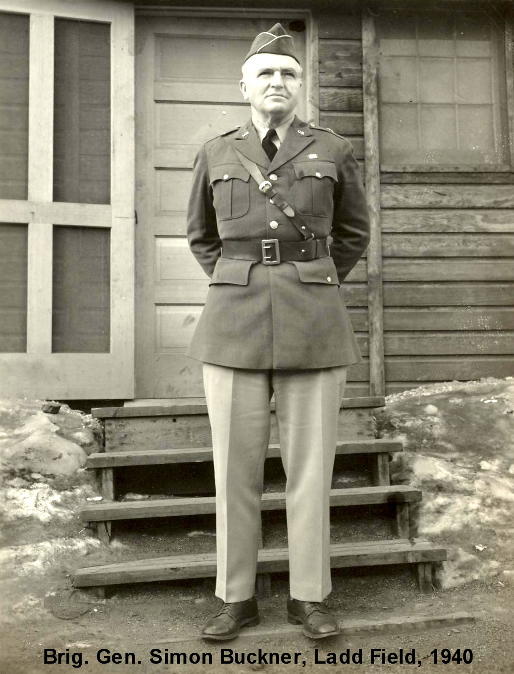
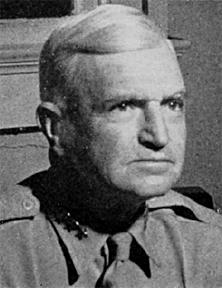
Simon B. Buckner Jr, as a newly
promoted Brigadier General in Alaska.
This photo shows Buckner only a year or so after he commanded the
22nd Infantry.
Photo from the Freelance Work by Steve Dennis website
Prior to Pearl Harbor,
Buckner was promoted to Brigadier General and assigned as
commander of the
Army's Alaska Defense Command. While commanding all US troops in
Alaska Buckner was involved in the
defense of Dutch Harbor on the island of Unalaska, operations
against the Japanese seizure of the
islands Kiska and Attu (June 1942), the Battle of Attu (Operation
Landcrab, May 1943),
and the invasion of Kiska (August, 1943).
In July,
1944, Buckner was sent to Hawaii to organize the Tenth Army,
which was composed of both
Army and Marine units. The original mission of the Tenth Army was
to prepare for the invasion of Taiwan;
however, this operation was canceled, and Buckner's command was
instead ordered to prepare for
the Battle of Okinawa. This turned out to be the largest,
slowest, and bloodiest sea-land-air battle
in American military history.
7
Buckner was the overall
commander of all US ground forces engaged in the battle of
Okinawa.
On June 18, 1945 Buckner was on Okinawa, watching combat
operations of the 8th Marine Regiment
when he was hit by shrapnel from a Japanese 47mm explosive shell.
His wounds proved to be fatal.
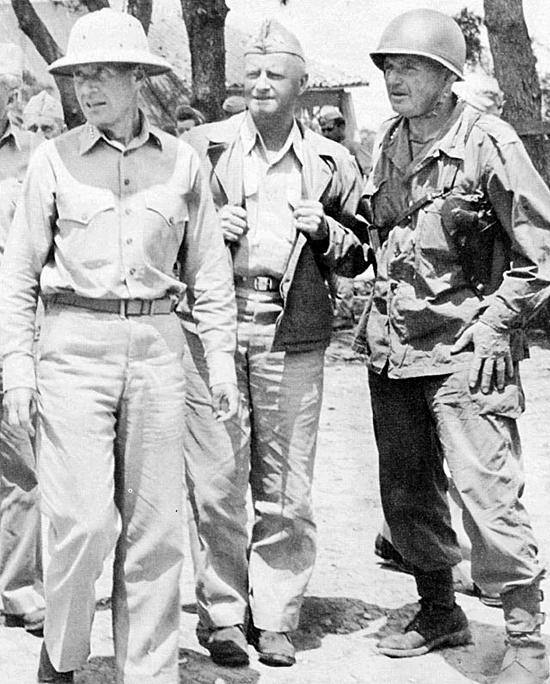
AMERICAN COMMANDERS in
Operation ICEBERG, the battle for Okinawa, left to right:
Admiral Raymond A. Spruance, Fleet Admiral Chester W. Nimitz, and
Lt. Gen. Simon B. Buckner Jr.
Photo from United States
Army in World War II The War in the Pacific Okinawa: The Last
Battle
by Appleman, Burns, Gugeler, and Stevens, CENTER OF MILITARY
HISTORY US ARMY 1948
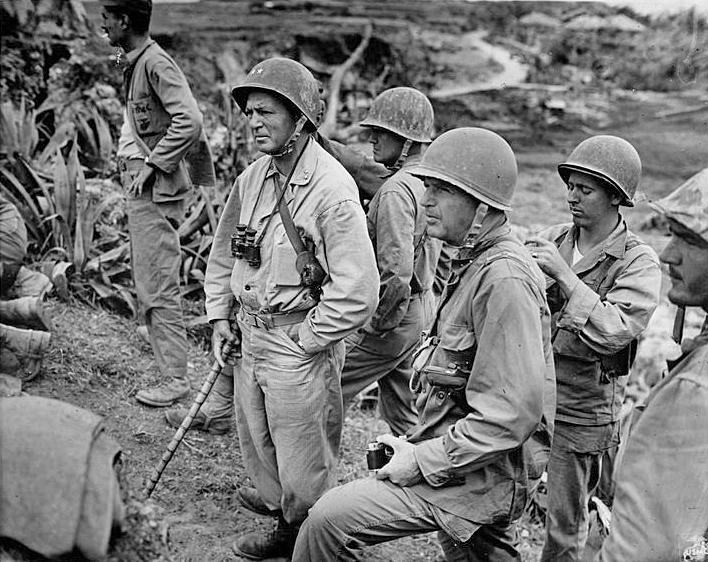
On Okinawa, Lt. General Simon B.
Buckner Jr., (foreground, holding camera),
photographed with Major General Lemuel C. Shepherd, Jr.,
Commanding General, 6th Marine Division
US Marine Corps photo
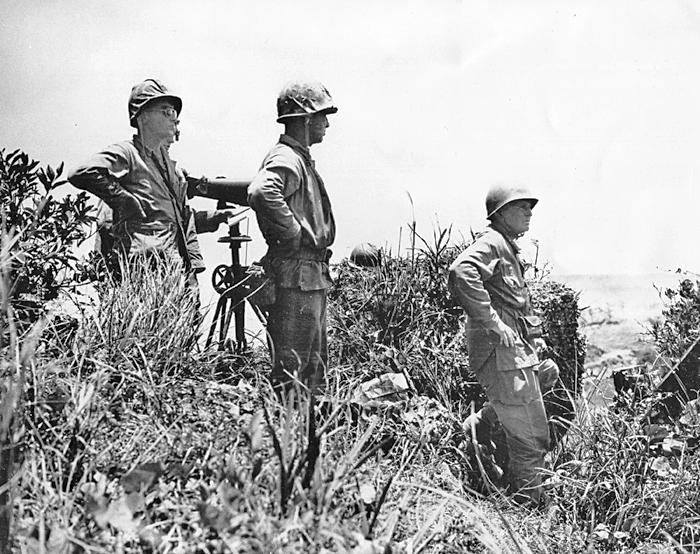
This is the last photograph taken of
LtGen Simon B. Buckner, Jr., USA, right, just before he was
killed on 18 June, 1945.
He was observing the 8th Marines in action on Okinawa for the
first time since the regiment entered the lines in the drive to
the south.
Note the rock and coral outcropping to his left. The shell that
exploded hit that outcropping, dispersing fragments into the
general
which proved to be fatal. The other two staff officers were not
seriously hurt.
USMC photo
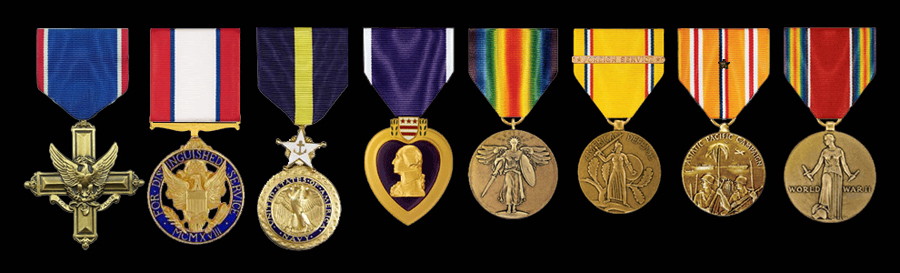
Simon B. Buckner Jr.'s decorations
 8
8
Simon B. Buckner, Jr. Class of 1908
No. 4699 n 18 Jul 1886 – 18 Jun 1945
Killed In Action near Mezato, Okinawa, Japan ¤ Interred near Hagushi Beach, Japan
He was the only son of the Kentucky soldier whose name he bore, and of Delia Hayes Claiborne of Richmond, VA.
The Buckner home, where he was
born, was built in the early 19th Century by his grandfather.
Simon Bolivar Buckner, Jr.,
was the only child of his fathers second marriage. Of his boyhood
days he once wrote for an article appearing in Time.
"I went barefooted hunted, trapped, fished, swam, canoed,
raised chickens, fought roosters, rode five miles daily for the
mail,
trained dogs, did odd farm jobs, learned not to eat green
persimmons, and occasionally walked eight mules to Munfordville
to broaden my horizon by seeing the train come in, learning the
fine points of horse trading, or listening to learned legal
and political discussion on county court day."
After attending various schools
near home, he spent two years at the Virginia Military Institute
whence he received his
West Point appointment from President Theodore Roosevelt,
entering 16 Jun 1904 and graduating 14 Feb 1908,
number 58 in a class finally numbering 108. He took his academic
course in stride, holding his position about mid-class
with little effort. In the battalion of that day, he was a
corporal, a sergeant, and finally a lieutenant. Without excelling
in athletics,
he played scrub football, was a member of our indoor meet teams,
and gave much time to boxing and wrestling under Tom Jenkins.
He ranked high in "dis," earning all the Christmas
leaves possible under the demerit rules of that day, and had a
standing date
to spend each in Washington, where he was the bright spot of
every party he attended. At each annual class meeting,
he always was returned second ranking hop manager.
Upon graduation he was assigned
to the 9th Infantry. To show how earnestly he took his chosen
career, he devoted part
of his graduation leave to a trip to the Canal Zone, where the
job was approaching its maximum swing. Here he stayed
with the chief engineer who was very fond of him; he hiked for
miles through the Cut and over the lock sites, rode dirt trains,
and pounded jungle trails for his first taste of what moving foot
troops over such ground and in such climate would mean.
Thus began the preparation for his supreme command. It might be
said his whole career was ideally patterned for that climax
but it will be enough in this sketch to name the more important
details. He began to know the Philippines from a tour in Cebu
during 1910-12. After various details in the U.S., which included
a year as assistant superintendent of Public Buildings and
Grounds in Washington, he returned to the Philippines for another
year in 1916, now with the 27th Infantry,
spent between Manila and Baguio.
While on this tour he went on
leave to marry Miss Adele Blanc of a well-known New Orleans
family, the wedding taking place
in Louisville, KY, 30 Dec 1916. Of this happy union were born
three children: Simon Bolivar Buck-ner III at Louisville, KY,
18 Nov 1918; Mary Blanc Buckner at West Point, NY, 22 Aug 1922;
and William Claiborne Buckner at Ft. Leavenworth, KS,
29 Jun 1926. Simon is a veteran of WWII, having come up through
the ranks and served overseas with distinction through
North Africa, Sicily, Italy, and France with the 927th Signal
Battalion, attaining the rank of captain. Mary graduated from
Stanford University in December 1945. William, in the Class of
'48, graduated just 104 years after that of his illustrious
grandfather.
If Simon Buckner, Jr., was
disappointed to miss action in WWI, he contributed valuably to
training the more fortunate,
for at Kelly Field, TX, as major in the Aviation section of the
Signal Corps, he successively commanded and put through
the traces the 5th Provisional Regiment, SC, and other units
including the 1st and 3rd Training Brigades. In August 1918,
he was with the Operations section of the Air Service in
Washington, becoming, in October, a student at the War College.
In May 1919, after assignment to the 83rd Infantry, came his
first detail to West Point as instructor of Infantry tactics,
commanding a battalion of cadets.
After four years of this came a
detail as student at the Infantry School at Ft. Benning, followed
by CGSC at Ft. Leavenworth,
which he completed as a distinguished graduate, remaining to
instruct for an additional three years. Then came another
four years at the Army War College where, after completing the
one-year course, he remained as executive officer until 1932.
That year saw his return to West
Point, this time as assistant to the commandant of cadets for one
year, then as
commandant for three years until June 1936. His rule is
remembered for constructive progressiveness, with a share of
severity tempered with hard, sound sense, and justice.
His regime, as commandant thus
highlighted and typified, marks him as an outstanding leader
among those to fill that
important office. To honor his service, Camp Popolopen, now the
summer training camp for the cadets, has been redesigned
and named Camp Buckner.
The succeeding four years found
him on short details all over the country from Texas to
Massachusetts: as umpire
at maneuvers, taking refresher courses, organizing and training,
attaining his colonelcy in January 1937. In July 1940
came his first real opportunity for important troop service when
he was put at the head of the Alaskan Defense Command
at Ft. Richardson, attaining the rank of permanent brigadier
general on 1 September, one of the first of his class
to wear the star with troops.
His work in Alaska was that of a
pioneer. He built roads, bases, personally tested types of
clothing, boots and
sleeping bags, and maintained high morale despite weather and
terrain. Fully appreciating the value of cooperation
with the other branches of the service, he gave a fine example of
teamwork with the Navy. He spent much time flying
around the Aleutian chain. He became a major general, A.U.S., on
4 Aug 1941. On 4 Jun 1942, his fliers and those of the
Navy located a fleet of Japanese carriers, cruisers, and
destroyers patently bound for Dutch Harbor and drove them back,
despite fog and rain, with heavy loss and damage, thus defeating
the nearest actual threat to security of the Pacific Coast
region. His was the training of the Army task force, which
finally recovered Attu in May 1943. On the 4th of that month
he was promoted to lieutenant general, A.U.S.
(Ed., the above statement of
driving off the attacking Japanese force "with heavy loss
and damage" is innacurate.
William C. Buckner, the son of General Simon B. Buckner, stated
the following:
"The fact is that the
Japanese lost 1 fighter plane, 1 float plane, and 5 light
bombers,
so anyone who knows this fact would disagree with "heavy
losses".
Nevertheless, the raiding Japanese aircraft were concerned with
the
immediate and heavy, alerted AA fire, and the Army P-40 fighters
from a
nearby secret Army airbase which attacked the Japanese
bombers.")
During that summer of 1943 he
made an official visit to Washington during which he was host at
an impromptu
class gathering held at Harvey's. We found him unchanged, in
superb physical trim, boyishly jovial as ever, loving
his assignment, preaching his hobby of going all the way to
instill into his troops the creed of cooperation with those
in other arms of our service. He was so taken with the Alaskan
country that he bought property at Anchorage for a
permanent dwelling, and at Homer for a log cabin, planning to
make the Territory his home after the war. At Homer
the American Legion Post has been named after him.
In June 1944, he was assigned to
Central Pacific Area, Ft. Shafter, Territory of Hawaii, where he
began training of units
later to constitute the Tenth Army. Here he was most exacting in
the physical tests and fitness demanded of his officers
and men, and in the following silent months he was whipping his
command into shape for one of the most vital campaigns
of the whole war— Okinawa. How well this was done is given
in words of Secretary Forestal in citation for the
Navy Department's Distinguished Service Medal, posthumous:
"Charged with training and equipping the Tenth Army
for the Okinawa Campaign, LTG Buckner developed each unit to a
high state of combat readiness, integrating the whole
as a formidable fighting command. Rendering invaluable assistance
throughout die planning phase, he subsequently
cooperated wholeheartedly with amphibious commanders during
landing operations and immediately established his
lines of supplies and communications when the beachheads were
secured. Skillfully coordinating the fire power of all
branches of the armed services under his command, he boldly
executed maneuvers designed to neutralize savage
Japanese resistance and despite the difficulties of extremely
rugged terrain and adverse weather which frequently
delayed the movements of both men and equipment, relentlessly
pressed onward toward the objective, constantly
rallying his tired, depleted troops and waging furious
battle..."
In the combined operation for
which GEN Buckner commanded the Army troops, he launched the
offensive on the
Ryukyus when his 77th Division landed on Kerama Retto on 26 Mar
1945, and in three days secured all small islands
in that chain and brought Okinawa, the key island, within
artillery range. Then on 1 April, the XXIV Army Corps and
III Marine Corps established beachheads along the west coast near
Kadena. After a drive across the island, the latter
swung north and soon mopped up all the northern portion. The
former, swinging south, ran into the stiffest, most
stubborn opposition of the Pacific War requiring all the
ingenuity and leadership of the commanding general to bring
eventual success. The citation for his Distinguished Service
Cross, posthumous, says: "After planning and directing
all phases of his army's activities in the Okinawa operation, GEN
Buckner had forced the Japanese to the southern tip
of the island. Realizing that decisive action would undoubtedly
result, he joined a forward regiment and proceeded to a
battalion observation post approximately 300 yards behind the
front lines closely to supervise the action of his troops."
He had been struck by a shell
fragment. Despite the efforts of a Medical officer with him, GEN
Buckner was
pronounced dead ten minutes after being hit. Thus passed the
officer of highest rank in the U.S. Army in this war
to lose his life in action while exercising troop command. In a
matter of hours, the fighting in Okinawa was over, but it
was written he might not witness the final victory. Had he been
able so to read, his course would have been no different.
He would not have complained. Through and through he was a
soldier. The next day he was laid to rest beside comrades
in the cemetery of the 7th Infantry Division, near Hagushi Beach,
where he had led his men ashore that Easter Sunday—
there to "find a soldiers resting place beneath a soldier's
blow."
Of the many traits of leadership
he displayed, mention has been made of the "get-along"
spirit with which he inculcated
his component of a mixed command. It is interesting to note the
reaction of his Navy comrades. In the Alaskan days
he worked closely with Admiral Thomas C. Kinkaid, and of this
association the admiral writes: "If the Japanese forces
penetrated to the eastward of a certain meridian, Army interests
were to be considered 'paramount'. If they remained to
westward of that line, Navy interests were 'paramount'. In each
case the other commander was to cooperate with
and to coordinate with, the commander having paramount interest.
As all of the operations were to the westward,
the Navy was in direct command. GEN Buckner gave a full measure
of cooperation. I could not have asked for
greater courtesy and consideration. We made a point of consulting
each other and of keeping each other informed.
All important dispatches were discussed before sending, and they
invariably ended with 'Buckner concurs' or
'Kinkaid concurs' depending upon who was the originator. When GEN
Buckner was killed on Okinawa, I lost a friend
whom I had learned to admire and trust, and the armed services
lost a gallant and courageous officer of high integrity."
What a pattern to lay before those engaged in the study of future
joint operations!
On 19 Jun 1945, on the floor of
the Senate, this tribe was paid by Senator Chandler of Kentucky:
"This ruddy-faced,
white-thatched apostle of the vigorous life had seen the new
United States Tenth Army drive deeper and deeper into
enemy territory in Okinawa until at last he stood on the
threshold of complete victory on that important battlefield.
Fate deprived him of seeing the curtain run down on one of the
most important acts that foretells the fall of Japan.
He leaves behind him a heritage as rich as that received from his
father. It was the will to win that characterized
Simon Bolivar Buckner as he met his death on Okinawa. A man who
attacked life aggressively, he never asked the men
under his command to do a job he would not do himself."
President Truman, in citation
for award of the Purple Heart, posthumous, sets forth that
"in the unbroken line of patriots
who have dared to die that freedom might live ... he
lives—in a way that humbles the undertakings of most
men."
His classmates and friends who
glimpsed the early signs of his promising qualities take pride in
all the words of
high praise, which acclaim their realization. And as we broadly
view his whole career and personality, we may also
humbly add, as one of them suggests, those lines of Kipling:
"E'en as he trod that day to God, so walked he
from his birth, in simpleness and gentleness and honour and clean
mirth."
—A classmate 9
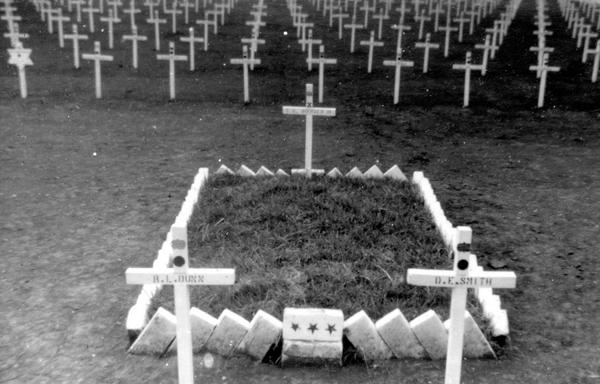
Buckner's grave near Hagushi Beach,
Okinawa. He was first buried here, in the Tenth Army Cemetery on
Okinawa and later
his remains were taken back to Kentucky to lie beside his father
who was Civil War Confederate Lieutenant General
and Kentucky Governor Simon Bolivar Buckner Sr.
Photo from The Real Revo blog
Burial:
Frankfort Cemetery
Frankfort
Franklin County
Kentucky, USA
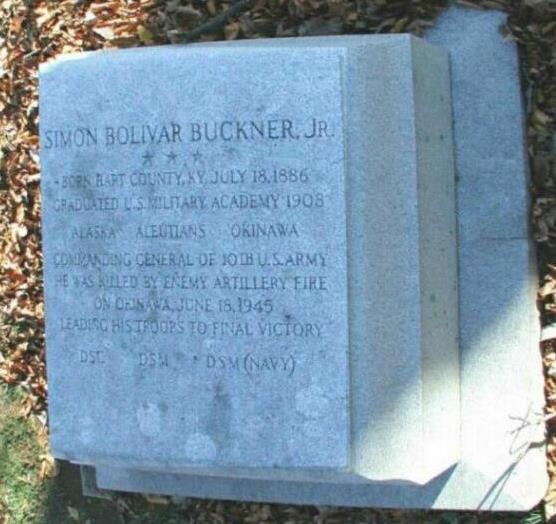
The grave marker for Simon B. Buckner
Jr.
Buckner is interred in the family plot at Frankfort Cemetery in
Frankfort, Kentucky.
Photo by Bill Davis from the Find A Grave website
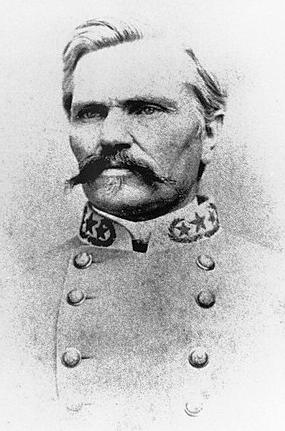
Lieutenant General Simon Bolivar Buckner
1823 - 1914
Simon Bolivar Buckner was the
father of General Simon Bolivar Buckner Jr.
Buckner (senior) was a graduate of the US Military Academy
(1844). He served in Mexico,
in the 6th Infantry during the Mexican-American War and resigned
from the Army in 1855.
At the beginning of the Civil War he turned down a commission as
a Brigadier General in the US Army
and accepted a commission as a Brigadier General in the Army of
the Confederacy, eventually rising
to Lieutenant General. After the War he served a term as Governor
of the State of Kentucky.
**********************
Troop transport named after General Simon B. Buckner Jr.
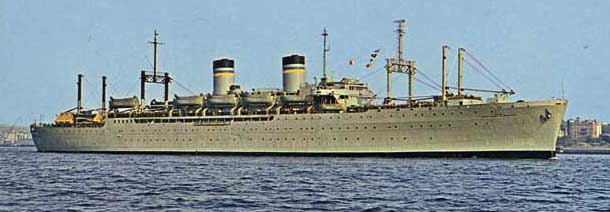
USNS General Simon B. Buckner T-AP-123
USNS General Simon B. Buckner (T-AP-123),
1945-1997.
Previously USS Admiral E. W. Eberle (AP-123) and U.S. Army
Transport General Simon B. Buckner
USS Admiral E. W. Eberle, a 9,676-ton (light
displacement) Admiral W. S. Benson-class transport built by the
Maritime Commission to its P2-SE2-R1 design,
was commissioned in January 1945 with a largely Coast Guard crew.
She departed San Francisco in March with troops and supplies for
the Southwest Pacific,
then moved to the Philippines where she embarked over 2,000
formerly interned civilians for repatriation to the United
States. After arriving at San Pedro,
California, in early May Admiral E. W. Eberle went to the
Atlantic, where in June and early July she made a crossing
carrying troops from Naples, Italy
to Trinidad and another returning servicemen to the United States
from Le Havre, France. In July and August the transport carried
troops from Marseilles,
France to the Philippines. After upkeep at Seattle, she made
three voyages from the West Coast to Japan and Korea between
October 1945 and March 1946
. Admiral E. W. Eberle was decommissioned in May 1946 and
transferred via the Maritime Commission to the Army.
The Army soon renamed the ship General Simon B. Buckner
and operated her with a civilian crew as part of its water
transportation service.
She returned to the Navy in March 1950 when most of the larger
Army ships became part of the newly-created Military Sea
Transportation Service.
Still civilian-manned and retaining her "General" name,
the ship made numerous crossings of the Pacific in support of the
Korean War. In February 1955
she departed San Francisco for New York, and during the next ten
years completed over 130 Atlantic voyages between New York and
Bremerhaven,
West Germany, with some stops at Southampton, England, and trips
to the Mediterranean. Between August and December 1965 the
Buckner twice steamed
from California to Vietnam, then returned to the East Coast and
made ten more trips from New York to Bremerhaven and Southampton.
She moved definitively
to the West Coast in August 1966, supporting U.S. operations in
Southeast Asia until March 1970, when she was placed out of
service and returned to the
Maritime Administration. Laid up during the following two
decades, USNS General Simon B. Buckner was stricken from the
Naval Vessel Register in August 1990
and sold by the Maritime Administration in June 1997 for
scrapping.
To visit a memorial page for Simon Bolivar Buckner Jr., click on the following link:
1 Top photo of Colonel Simon B.
Buckner Jr., as Commanding Officer 66th Infantry (light tank)
Regiment,
probably taken July 1937 at Fort Meade Maryland, courtesy of
William C. Buckner
2 THE DOUGHBOY 1924,
Published by the Classes of 1924,
The Infantry School, U.S. Army, Fort Benning, Georgia, 1924
3 Simon Bolivar Buckner:
Borderland Knight
by Arndt Stickles
Publisher UNC Press Books, 2001
ISBN 0807853569, 9780807853566
4 Courtesy of William C. Buckner
8 2008 Register of Graduates and Former Cadets
9 2008 Register of Graduates and Former Cadets
A special thanks to William C. Buckner, the son of General Simon B. Buckner Jr., for assistance in the preparation of this page.
Home | Photos | Battles & History | Current |
Rosters & Reports | Medal of Honor | Killed
in Action |
Personnel Locator | Commanders | Station
List | Campaigns |
Honors | Insignia & Memorabilia | 4-42
Artillery | Taps |
What's New | Editorial | Links |